Supply Chain Sustainability Policy and Governance

Build the Systems That Make Your Commitments Verifiable

Supply chain sustainability governance is the set of policies, procedures and risk management systems that define how an organization manages ESG responsibilities across its supply chain. Clearyst develops procurement policies, due-diligence processes, supplier codes of conduct and integrated risk management systems, and prepares companies for EcoVadis ratings, B Corp certification, CSRD disclosure and CSDDD compliance.
Most companies have sustainability commitments. Fewer have the governance infrastructure to prove how those commitments are managed.

For CSRD assurance, CSDDD due diligence, EcoVadis ratings and B Corp certification, the questions are practical:
Where are your policies?
Who owns the process?
How do you identify risk?
How do you track corrective action?
Clearyst helps companies answer those questions with documented, usable systems that stand up to external review.
The Definition

What Is Supply Chain Sustainability Policy and Governance?

Supply chain sustainability governance is the documented system of policies, procedures and risk management frameworks that defines how a company identifies, manages and reports ESG risks across its supply chain.

Policies vs. Procedures vs. Risk Management Systems

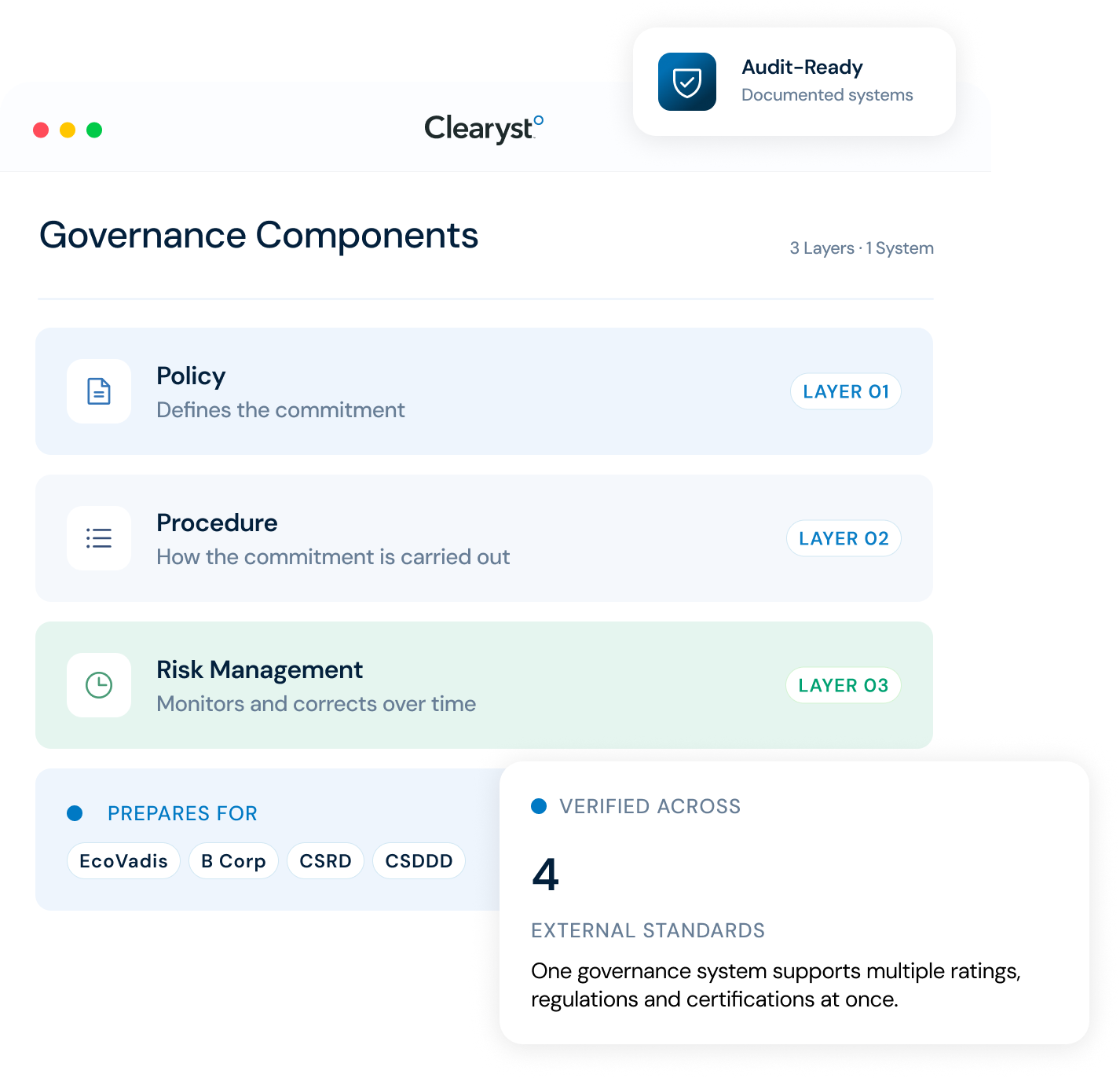
A sustainability policy defines the commitment. A procedure explains how that commitment is carried out. A risk management system identifies, prioritizes and monitors supply chain ESG risks over time.

All three are needed for credible governance.
Component 01
Policy
Defines the commitment.
Defines expectations for environmental management, supplier conduct, human rights, ethics and sustainable procurement.
Component 02
Procedure
Carries the commitment out.
Documents how suppliers are onboarded, assessed, monitored and escalated when issues arise.
Component 03
Risk Management System
Monitors performance over time.
Tracks supplier risk, assessment cycles, corrective actions and ongoing performance.
Clearyst builds these components as standalone deliverables or as an integrated governance system aligned to EcoVadis, B Corp, CSRD or CSDDD requirements.
Why It Matters

Why Governance Is the Foundation of Sustainability Performance

A GHG Inventory
Without data governance is harder to verify.
An EcoVadis Submission
Without policies and evidence will underperform.
A B Corp Application
Without documented stakeholder management will stall.
A CSDDD Program
Without procedures creates legal and operational risk.
Governance is not paperwork. It is what makes sustainability measurable, auditable and repeatable.
Our Approach

How Clearyst Builds Supply Chain Sustainability Governance

Clearyst builds supply chain sustainability governance through four stages: baseline assessment, policy and procedure development, risk management system design and external assessment preparation. The result is a documented governance program aligned to the company's obligations and business priorities.

01 Governance Baseline Assessment

Review existing policies, procedures, scorecards and risk practices against applicable standards and rating requirements.

02 Policy and Procedure Development

Develop or strengthen policies for environmental management, supplier conduct, human rights, labor standards, ethics and sustainable procurement.

03 Risk Management System Design

Build supplier risk registers, tiering frameworks, due-diligence workflows, corrective action processes and monitoring cadences.

04 External Assessment Preparation

Prepare evidence files, questionnaire responses and documentation for customers, EcoVadis, B Corp, CSRD assurance or CSDDD review.
The goal is not a generic governance framework. It is a working system your teams can use.
Our Services

Supply Chain Sustainability Policy and Governance Services

Clearyst provides sustainability policy development consulting, supply chain due diligence consulting and assessment preparation for companies building stronger ESG governance across their supply chains.

01 Sustainability Policy Development and Procedure Design

Clearyst develops and strengthens the policies companies need to manage sustainability risk and satisfy external assessors. This includes:
  • Environmental management policies
  • Supplier codes of conduct
  • Human rights and labor standards policies
  • Ethics and anti-corruption policies
  • Sustainable procurement policies
  • Governance responsibility matrices
  • Training, acknowledgment and review procedures
Policies written only for an assessor create risk. Clearyst builds policies that reflect how the business operates and can be supported with evidence.

02 Supply Chain Due Diligence and Risk Management Systems

Supply chain due diligence requires a documented way to identify, assess and manage ESG risks. Clearyst helps companies build:
  • Supplier risk classification systems
  • ESG screening methodology
  • Risk registers and supplier tiers
  • Grievance and corrective action workflows
  • Monitoring and review schedules
  • Documentation for regulatory and customer review
These systems help procurement, compliance and sustainability teams focus resources where risk is highest.

03 EcoVadis Consulting Services and Score Improvement

EcoVadis ratings are often tied to customer requirements, preferred supplier status and contract opportunities. Clearyst supports EcoVadis preparation through:
  • EcoVadis gap analysis
  • Policy and evidence review
  • Documentation development
  • Questionnaire preparation
  • Score improvement planning
  • Annual renewal strategy
For many companies, improving an EcoVadis score starts with stronger policy documentation and clearer evidence of management systems.

04 B Corp Certification Consulting

B Corp certification is voluntary, but the process requires rigorous governance documentation and evidence of stakeholder impact management. Clearyst helps companies prepare by:
  • Reviewing readiness against B Lab standards
  • Identifying policy and procedure gaps
  • Preparing governance documentation
  • Organizing evidence for review
  • Supporting B Impact Assessment preparation
  • Advising on required governing document changes
The governance built for B Corp can also strengthen EcoVadis performance, CSRD disclosure readiness and broader sustainability management.
Business Drivers

4 Forces Requiring Documented Supply Chain Governance

Supply chain governance is no longer optional. Regulations, customers, ratings platforms and certification bodies increasingly expect companies to show documented policies, defined procedures and evidence of risk management.
CSRD and Sustainability Disclosure
CSRD requires companies to disclose governance arrangements, risk management processes and internal controls tied to sustainability.

Assurance providers do not just review disclosure language. They review the systems behind it. Clear policy ownership, due-diligence procedures and documented evidence trails help companies support what they repor
EcoVadis Rating Requirements
EcoVadis evaluates companies across environment, labor and human rights, ethics and sustainable procurement. Policy documentation, management systems and evidence of action directly influence scoring.

For companies trying to improve an EcoVadis score or meet a customer's rating threshold, governance is often the highest-impact improvement area.
EUDR, Supply Chain Transparency and Emerging Risk Requirements
Supply chain due diligence expectations are expanding across commodity traceability, forced labor screening, human rights disclosure and supplier risk monitoring.

Companies need more than supplier questionnaires. They need a repeatable system for identifying risk, documenting decisions and taking corrective action.
CSDDD and Supply Chain Due Diligence
The Corporate Sustainability Due Diligence Directive requires in-scope companies to embed human rights and environmental due diligence into policies and decision-making processes.

That means companies need procedures for identifying adverse impacts, preventing and correcting issues, managing complaints and monitoring supplier performance. Clearyst helps companies build those systems before deadlines make the work urgent.

Frequently Asked Questions About Supply Chain Sustainability Policy and Governance

1. What sustainability policies does my company need?
Most companies need an environmental management policy, supplier code of conduct, human rights and labor standards policy, ethics and anti-corruption policy and sustainable procurement policy. The specific requirements depend on your reporting obligations, customer requirements and certification goals.
2. What is supply chain due diligence?
Supply chain due diligence is the process of identifying, assessing, preventing and addressing human rights and environmental risks across suppliers and business relationships. It requires documented procedures, supplier risk screening, corrective action processes and ongoing monitoring.
3. How do I improve my EcoVadis score?
Start with a gap analysis across EcoVadis’ four themes: environment, labor and human rights, ethics and sustainable procurement. The most common improvement areas are policy documentation, evidence of management actions, supplier assessment processes and measurable results.
4. What is the difference between EcoVadis and B Corp?
EcoVadis is a supply chain sustainability rating often required by enterprise customers. B Corp is a voluntary certification issued by B Lab for companies that meet stakeholder impact standards. Both require documented policies, procedures and evidence of management systems.
5. How long does EcoVadis preparation take?
EcoVadis preparation typically takes four to eight weeks, depending on the maturity of existing policies, evidence files and management systems. Companies with limited documentation may need more time to build the required materials.
6. What governance changes does B Corp certification require?
B Corp certification requires companies to document stakeholder impact management and amend governing documents to consider stakeholder interests, not only shareholder interests. Companies also need evidence across B Lab’s impact areas before verification.

Build the Governance Infrastructure Your Sustainability Program Actually Needs

Sustainability commitments that are not documented, owned and monitored do not satisfy assessors, customers or regulators.

Whether your driver is an EcoVadis requirement, B Corp certification, CSRD assurance or CSDDD readiness, Clearyst helps build the policies, procedures and risk systems your program needs to stand up.
Talk to a Governance Consultant
Governance is what turns sustainability commitments into evidence, action and accountability. See Our Sustainability Services →