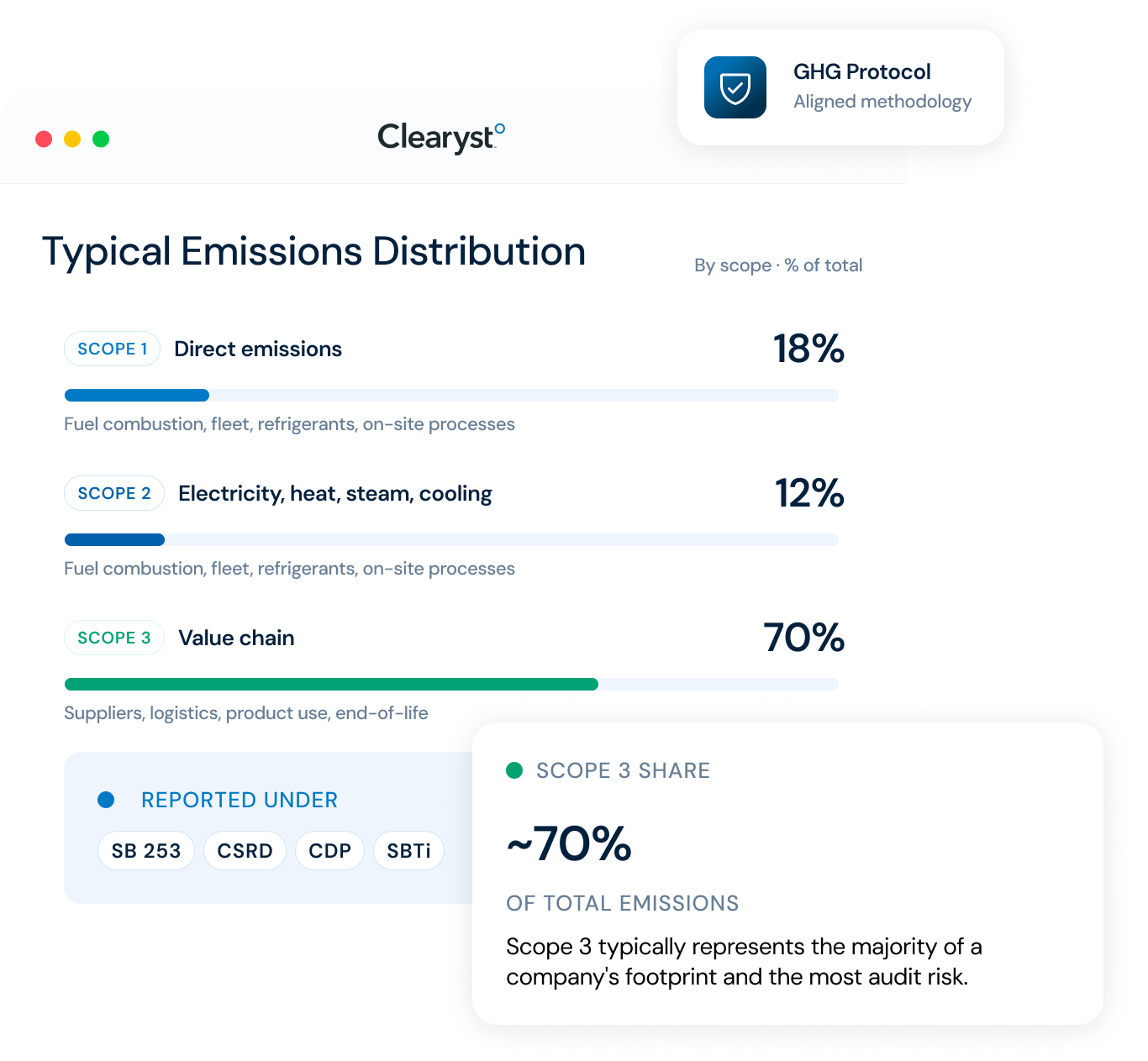
Scope 1, 2, and 3 Emissions

How to Calculate Scope 1, 2, and 3 Emissions And Report with Confidence

Scope 1 emissions are direct greenhouse gases from operations a company owns or controls. Scope 2 covers indirect emissions from purchased electricity and energy. Scope 3 covers all other indirect emissions across the value chain, often representing the majority of a company's total footprint. Calculating all three accurately requires boundary-setting, a thorough understanding of a company's emissions drivers, data collection, and audit-ready documentation.
Most teams don't struggle with what Scope 1, 2, and 3 emissions are. They struggle with navigating data complexity.
Which entities belong in your boundary?
How do you ensure Scope 3 data accuracy?
How do you collect supplier data that holds up under scrutiny?
And once the numbers are calculated, will they pass assurance?

That's where Clearyst comes in. We help companies move from fragmented data and assumptions to structured, audit-ready emissions reporting.
The Definition

Scope 1, 2, and 3 Carbon Emissions Defined

Scope 1 covers direct GHG emissions from sources owned or controlled by the company. Scope 2 covers indirect emissions from purchased electricity, heat, steam, or cooling. Scope 3 covers all other indirect emissions across the value chain, including purchased goods, logistics, business travel, product use, and end-of-life treatment.
Scope 1
Direct Emissions
From sources you directly control.
Fuel combustion, company vehicles, industrial processes, and refrigerants.

In most cases, this is the cleanest dataset to work with. Data typically comes from internal records like utility bills, fuel logs, and facility systems. The challenge is less about access and more about consistency across locations and operations.
Scope 2
Purchased Energy
From purchased electricity and energy.
Most companies must calculate Scope 2 using two methods:

Location-based: Reflects average grid emissions

Market-based: Reflects contractual energy choices (RECs, PPAs, supplier rates)

Both are required under most disclosure frameworks. The difference between them can materially impact reported emissions, and needs to be clearly documented.
Scope 3
Value Chain Emissions
Everything else.
Your supply chain, logistics, business travel, product use, and end-of-life.

It is typically the largest share of total emissions. It also introduces the most variability in methodology, data quality, and audit risk.

For most companies, this is where emissions calculation shifts from a data exercise to a cross-functional business process.
Scope 3 Detail

The 15 Categories of Scope 3 Emissions

The GHG Protocol defines 15 Scope 3 categories across upstream and downstream activities. Not every category will be relevant, but identifying the right ones is critical.

Upstream Categories

8 categories
01
Purchased goods and services
02
Capital goods
03
Fuel- and energy-related activities
04
Upstream transportation and distribution
05
Waste generated in operations
06
Business travel
07
Employee commuting
08
Upstream leased assets

Downstream Categories

7 categories
09
Downstream transportation and distribution
10
Processing of sold products
11
Use of sold products
12
End-of-life treatment of sold products
13
Downstream leased assets
14
Franchises
15
Investments
In practice, most companies find that just a few categories drive the majority of emissions. A focused materiality screening helps prioritize effort, improve data quality, and avoid unnecessary complexity.

If you're early in the process, this is often the most important place to start.
Why Now

Why Scope 1, 2, and 3 Calculation Is Harder Than It Looks

The calculation frameworks are public. The challenge is applying them correctly.

Scope 1, 2, and 3 emissions calculation requires a series of decisions that directly affect your results and your ability to defend them.
Boundary-Setting
Which entities and operations are included?
Emission Factors
Are they current, consistent, and appropriate?
Scope 3 Methods
When do you use supplier-specific vs. spend-based?
Data Quality
Is your data complete enough to support reporting?
Documentation
Can every number be traced and explained?
If your emissions calculation cannot be explained, it cannot be verified.
These are not technical details; they are audit risks.

The GHG Protocol updates in process raise expectations further, with increased emphasis on traceability and primary data. For companies reporting under SB 253, CSRD, or investor frameworks, this is no longer optional.
Scope & Obligations

Does your company need to comply with CSRD?

Under the revised CSRD framework approved in February 2026, companies must comply if they have 1,000+ employees and €450M+ in annual net turnover and are EU-based, listed on an EU regulated market, or a non-EU group with significant EU revenue. If you're unsure whether you're in scope, that determination itself is the first step.
A Platform May Be Enough If...
You Need Consulting Expertise If...
You are tracking emissions internally
You have a regulatory deadline
Your footprint is primarily Scope 1 and 2
Scope 3 is material
Your team owns methodology decisions
You need audit-ready reporting
Your data is centralized and clean
You are building processes from scratch
Clearyst works alongside whatever tools you use. Our role is to ensure the methodology, data structure, and documentation are sound.

Most companies don't fail because of their platform; they fail because of how the inventory was built.
Talk to a Emissions Consultant
Our Services

Clearyst Scope 1, 2, and 3 Emissions Calculation Services

Accurate emissions calculation requires more than assembling data. It requires structure, consistency, and defensible decisions at every step.

Clearyst helps companies build emissions calculations that stand up to internal review, external scrutiny, and regulatory reporting.

01 Emissions Boundary-Setting and Scope Definition

Emissions boundary-setting defines what is included in your calculation and what is not. This decision drives every downstream number. Clearyst supports:
  • Defining equity share vs. operational control vs. financial control approaches
  • Mapping entities, subsidiaries, and facilities
  • Classifying emissions sources across Scope 1, 2, and 3
  • Aligning boundaries with regulatory requirements
Getting this right early reduces rework, improves accuracy, and avoids restatement risk later.

02 Scope 1 and Scope 2 Emissions Calculation

Scope 1 and 2 calculations establish the foundation for your emissions reporting. Clearyst helps teams:
  • Consolidate fuel, utility, and operational data
  • Calculate both location-based and market-based Scope 2 emissions
  • Apply consistent, current emission factors
  • Document calculation logic for audit readiness
Strong Scope 1 and 2 data creates clarity across operations and supports credible target-setting and reporting.
Get Expert Help With Scope 1 and 2 Calculations

03 Scope 3 Emissions Calculation: All 15 Categories

Scope 3 emissions calculation is where most companies face complexity. Clearyst structures this process into manageable steps:
  • Materiality screening to identify high-impact categories
  • Method selection across supplier-specific, activity-based, and spend-based approaches
  • Supplier engagement focused on the most impactful contributors
  • Data collection and validation across procurement, logistics, and internal systems
  • Documentation of assumptions, factors, and methodologies
This approach balances accuracy with practicality. Scope 3 is also where emissions reporting connects to supply chain strategy, risk management, and supplier engagement.
Get Expert Help With Scope 3 Calculations

04 Emissions Data Standardization and Management

Emissions reporting is ongoing. Without structure, it becomes harder each year. Clearyst helps organizations:
  • Standardize data formats and methodologies
  • Define data ownership across teams
  • Build repeatable annual reporting workflows
  • Maintain documentation and version control
The result is not just a completed calculation, but a system that improves over time.

05 Audit-Ready Emissions Reporting and Assurance Preparation

An emissions report is only as strong as the documentation behind it. Clearyst supports:
  • Preparing emissions reports aligned with regulatory frameworks
  • Documenting all assumptions, data sources, and emission factors
  • Reviewing calculations before submission
  • Building traceable evidence for assurance
Companies that build audit readiness early avoid delays, rework, and compliance risk. An audit-ready emissions report is not created at the end; it is built throughout the process.
Regulatory Landscape

Which Regulations Now Require Scope 1, 2, and 3 Reporting?

Scope 1, 2, and 3 reporting is no longer limited to voluntary disclosures. It is increasingly required across jurisdictions and frameworks.

California's SB 253, the EU's CSRD, and proposed regulations like New York's Climate Act all require expanded emissions reporting, including Scope 3.
Regulation or Framework
Who It Applies To
Scope 1 & 2
Scope 3
California SB 253
Large companies doing business in California
Required
Required
EU CSRD
In-scope EU and non-EU companies
Required
Required where material
NY Climate Corporate Data Accountability Act
Large companies doing business in New York (pending)
Expected
Expected
CDP
Investor/customer-driven disclosure
Ongoing
Ongoing
SBTi
Companies with science-based targets
Ongoing
Ongoing
Even where regulations are still emerging, market expectations are not. Customers, investors, and partners are already asking for complete emissions data.

Frequently Asked Questions About Scope 1, 2, and 3 Emissions

1. What is the difference between Scope 1, 2, and 3 emissions?
Scope 1 covers direct emissions from owned operations. Scope 2 covers indirect emissions from purchased energy. Scope 3 covers all other indirect emissions across the value chain, including suppliers, logistics, product use, and end-of-life.
2. How do I calculate Scope 3 emissions for my company?
Start with a materiality screening across all 15 categories. Then collect data from suppliers, procurement systems, and logistics records. Apply supplier-specific, activity-based, or spend-based methods depending on data availability and category importance.
3. What are the 15 Scope 3 emissions categories?
They include purchased goods, capital goods, transportation, waste, business travel, employee commuting, leased assets, product processing, product use, end-of-life treatment, franchises, and investments.
4. What is the difference between location-based and market-based Scope 2 emissions?
Location-based reflects average grid emissions. Market-based reflects your specific energy sourcing choices. Both are required under most frameworks and should be calculated consistently.
5. What does audit-ready mean for an emissions report?
It means every number can be traced to a data source, every assumption is documented, and the methodology is clearly defined. Assurance providers verify the process, not just the totals.
6. How long does it take to calculate Scope 1, 2, and 3 emissions?
Scope 1 and 2 can often be completed in 4–8 weeks. Scope 3 typically takes 3–6 months, depending on complexity, supplier engagement, and data availability.

Ready to Get Your Scope 1, 2, and 3 Emissions Right?

Whether you are building your first emissions calculation, expanding into Scope 3, or improving an existing process, the difference comes down to methodology and execution.

Clearyst helps companies produce emissions calculations that are accurate, audit-ready, and aligned with regulatory expectations.
Talk to an Emissions Consultant
The methodology is public. Getting the calculation right is the hard part. That's what we do. Explore Our Sustainability Services →