CSRD Consulting & Compliance

Navigate CSRD Compliance With Confidence

CSRD consulting helps companies determine their reporting obligations under the Corporate Sustainability Reporting Directive (CSRD), complete the required double materiality assessment, collect and manage ESRS-aligned data, draft their Sustainability Statement, and prepare for limited assurance.

Clearyst provides end-to-end CSRD consulting services for in-scope EU companies and non-EU companies with EU revenue exposure.
Speak with an Advisor
Scope & Obligations

Does your company need to comply with CSRD?

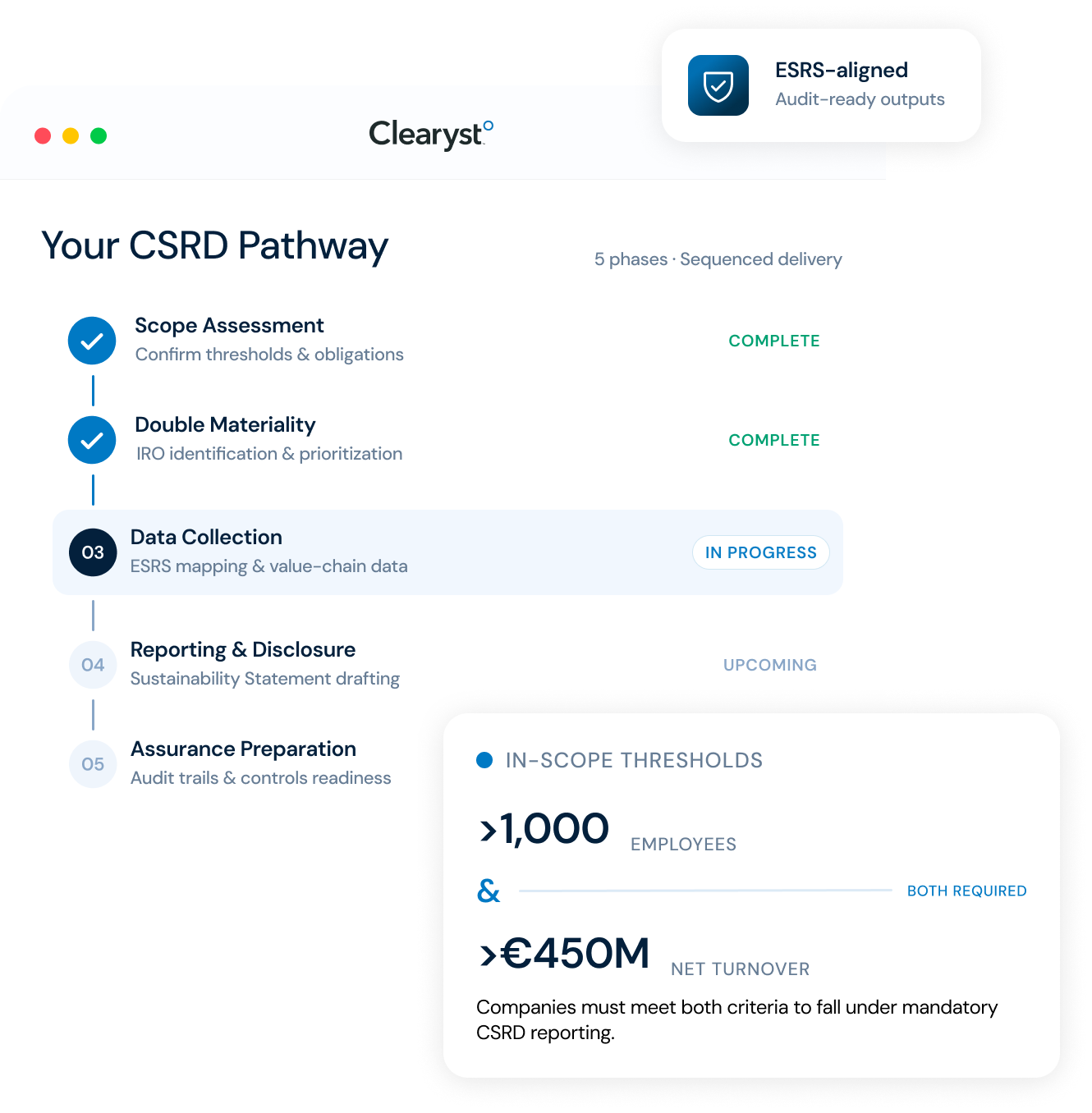
Under the revised CSRD framework approved in February 2026, companies must comply if they have 1,000+ employees and €450M+ in annual net turnover and are EU-based, listed on an EU regulated market, or a non-EU group with significant EU revenue. If you're unsure whether you're in scope, that determination itself is the first step.
COMPANY TYPE
THRESHOLD
REPORTING DEADLINE
Large EU companies
1,000+ employees AND €450M+ turnover
FY 2025 (reports in 2026)
Listed EU SMEs
Lower thresholds
FY 2026 (reports in 2027)
Non-EU parent companies
€450M+ EU revenue + €200M EU branch/sub
FY 2028 (reports in 2029)
Not sure where you stand? Talk to a Clearyst consultant →
Why It Matters

CSRD compliance isn't a project, it's a sequence

Many organizations underestimate their exposure, especially in the US. If you operate in the EU, generate revenue there, or have subsidiaries in-region, you may already be in scope.

Each phase builds on the last, and gaps early on create risk later. The most important step is clarity. Clearyst supports the full lifecycle, ensuring your program is complete, aligned, and audit-ready from the start.
Clear scope and obligation analysis
Double Materiality Assessment Execution
ESRS-aligned data systems
Audit-ready Sustainability Statements
Our Services

Clearyst° CSRD Consulting Services

End-to-end support across every phase of CSRD compliance — from determining scope to preparing for assurance.

01 CSRD Scope Assessment

Determines whether your company must comply with CSRD, when your first reporting deadline falls, and what the regulation requires from your specific organizational structure.
  • Confirm post-Omnibus threshold applicability
  • Evaluate non-EU exposure and entity structure
  • Identify reporting timelines and deadlines
  • Define applicable ESRS requirements
Business outcome: Clear, defensible understanding of your obligations — eliminating wasted effort and missed requirements.

02 Double Materiality Assessment

A mandatory first step under CSRD. Evaluates both impact materiality (how your activities affect people and environment) and financial materiality (how sustainability risks affect your business).
  • Identification of Impact, Risk, and Opportunity topics
  • Structured evaluation across both dimensions
  • Stakeholder-informed prioritization
  • A defensible materiality framework aligned to ESRS
Business outcome: A strong foundation that ensures your reporting is focused, relevant, and compliant.

03 Data Collection & Management

Gathering and validating ESG data aligned with ESRS requirements across your organization and value chain — with audit-readiness built in from the start.
  • Mapping ESRS data requirements to internal systems
  • Cross-functional data collection across teams
  • Supply chain and Scope 3 data integration
  • Scalable processes for repeatable reporting
Business outcome: Reliable, traceable data that reduces audit risk and accelerates reporting cycles.

04 CSRD Reporting & Disclosure

Structured, ESRS-aligned Sustainability Statement embedded within the management report and digitally tagged for submission.
  • Draft ESRS-compliant Sustainability Statements
  • Align disclosures to materiality outcomes
  • Integrate with GRI, TCFD, and ISSB frameworks
  • Implement iXBRL tagging requirements
Business outcome: A clear, structured report that meets regulatory requirements and builds stakeholder confidence.

05 Assurance Preparation

CSRD requires limited assurance — a third-party auditor must verify your disclosures. Preparation is critical, not optional.
  • Complete documentation and audit trails
  • Alignment with assurance expectations and controls
  • Identification of common risk areas early
  • Readiness before auditor engagement
Business outcome: Fewer surprises, faster audits, and stronger credibility with regulators and investors.
What to Expect

What to Expect From Clearyst as Your CSRD Partner

CSRD compliance is as much about execution as it is about interpretation. Here's how we partner with your team through every phase.
Regulatory fluency — We stay ahead of CSRD updates so you don't have to
Sequenced delivery — We manage the full process, not disconnected tasks
Business-first framing — Compliance aligns with strategy and operations
Audit-ready outputs — Everything is built for scrutiny
Hands-on execution — We work alongside your team through every phase
Context & Background

What Is CSRD — and What Changed in 2026?

The Corporate Sustainability Reporting Directive (CSRD) requires in-scope companies to publish a detailed Sustainability Statement covering environmental, social, and governance topics using the EU's ESRS standards.

In February 2026, the Omnibus package narrowed CSRD's scope to companies with 1,000+ employees and €450M+ in annual revenue, reducing the number of mandatory reporters by approximately 80%.

CSRD was introduced under the EU Green Deal to bring consistency, rigor, and comparability to sustainability reporting. Early versions created a significant operational burden, leading to the Omnibus update designed to simplify compliance.

ESRS-aligned disclosures

Standardized disclosures across environmental, social, and governance topics remain mandatory.

Embedded in management report

Sustainability Statements must be embedded within the company's management report — not reported separately.

Limited assurance required

Third-party auditors must verify disclosures. Preparation is critical before auditor engagement.

Non-EU companies impacted

Meaningful EU operations or revenue may still trigger CSRD obligations, even if headquartered outside the EU.

Frequently Asked Questions About CSRD

1. What is CSRD?
The Corporate Sustainability Reporting Directive (CSRD) is an EU regulation requiring companies to disclose ESG information using standardized ESRS frameworks, expanding the rigor and scope of sustainability reporting.
2. What changed with CSRD in 2026?
The 2026 Omnibus update narrowed scope to companies with 1,000+ employees and €450M+ turnover, reducing required reporters and simplifying compliance requirements.
3. Does my company need to comply if we’re US-based?
Possibly. Non-EU companies with significant EU revenue and operations may still be required to comply, with reporting starting in 2029.
4. What is a double materiality assessment?
It evaluates both environmental/social impact and financial risk to determine which ESG topics must be disclosed under CSRD.
5. What is a CSRD Sustainability Statement?
A formal ESG disclosure embedded in your management report, structured under ESRS and subject to assurance.
6. What is limited assurance?
A third-party audit of your sustainability disclosures to verify ESRS compliance.

Ready to Get Your CSRD Program on Track?

Whether you’re just starting to assess your obligations or already building your program, the next step is clarity.
CSRD doesn’t get easier by waiting, but it does get more manageable with the right structure and support.
Talk to a CSRD Consultant
CSRD doesn’t get simpler by waiting. Let’s figure out where you stand. Explore Our Sustainability Services →