

EPR Compliance for Packaging Producers: The 10-Step Producer Journey
Extended Producer Responsibility (EPR) laws are rapidly expanding, requiring producers to take accountability for the full lifecycle of their packaging. In 2025, the first wave of reporting requirements took effect across three states: Oregon in March, followed by Colorado in July, and California in November.
By May 31, 2026, reporting obligations will apply in six states—the original three, along with Minnesota, Maryland, and Washington. Meanwhile, eight additional states—Wisconsin, New York, New Jersey, Massachusetts, Rhode Island, Illinois, North Carolina, and Nebraska—have active or pending EPR legislation, signaling continued nationwide momentum.
These laws shift both financial and operational responsibility for recycling and disposal from taxpayers and local governments to producers, fundamentally reshaping how packaging waste is managed.
For producers, navigating EPR is complex—and rarely linear. Some requirements are one-time or vary by jurisdiction, while others recur annually or demand ongoing attention. To bring structure to this complexity, Clearyst has developed a ten-step framework that simplifies the EPR journey, helping producers understand and manage their responsibilities with greater clarity and confidence.
For many companies, EPR compliance can be overwhelming to manage internally. It often diverts time, resources, and attention away from core business priorities. Engaging an experienced EPR consultant can accelerate the process, ensure accurate and timely reporting, and uncover regulatory exemptions that might otherwise be missed.
Getting Started: Building Your EPR Compliance Team
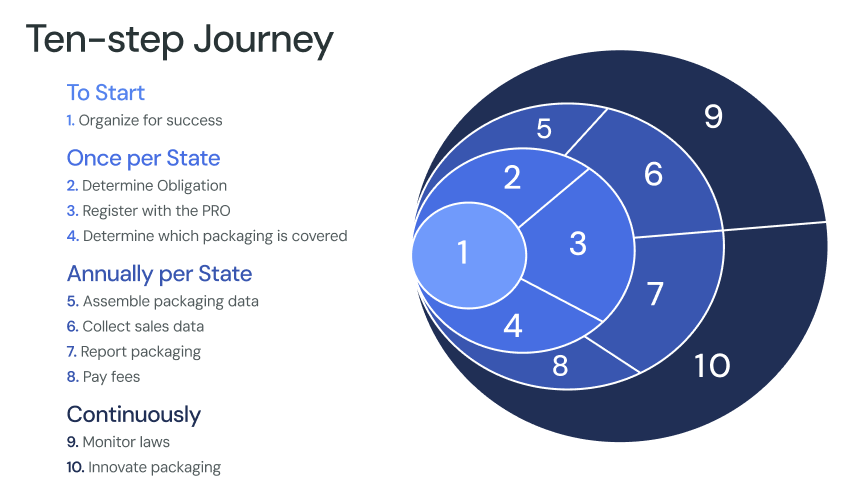
Step 1: Organize for EPR Compliance Success
Designate a responsible individual or cross-functional team—typically within compliance or packaging—to oversee the EPR process. This group will be accountable for gathering, validating, and submitting required data.
Given the scope of EPR regulations, this role often requires coordination across multiple departments, including compliance, supply chain, packaging development, sustainability, finance, legal, and product management.
Once-Per-State EPR Requirements: Determining Producer Obligations
Step 2: Determine Your Producer Obligation by State
EPR laws define "producers" as the entities responsible for packaging entering a given jurisdiction (usually a state). Determining whether your company is obligated requires a detailed review of each jurisdiction's rules.
Key considerations include:
- Product types
- Sales and distribution channels
- Branding and labeling
- Role in the supply chain
- Product classification
Some jurisdictions offer exemptions for small producers based on revenue or material volume thresholds.
Clearyst can guide and facilitate this process for you
Step 3: Register With the Circular Action Alliance (CAA)
Most EPR laws require producers to register with a Producer Responsibility Organization (PRO). In the U.S., the Circular Action Alliance (CAA) currently serves as the PRO for all approved state programs.
Registration enables your organization to:
- Participate in working groups
- Access regulatory guidance
- Submit and resolve compliance questions
At present, registration is free and completed through a single form covering all participating states.
Step 4: Identify Covered Packaging Materials by State
Determining which materials are subject to EPR requirements can be complex and varies by state.
Key considerations include:
- Packaging levels (primary, secondary, tertiary)
- Materials covered under other regulations
- Specialized or hard-to-classify packaging
- Distinctions between packaging and food serviceware
Clearyst can help simplify this process.
Annual EPR Reporting Requirements: Data, Submissions, and Fees
Step 5: Assemble SKU-Level Packaging Data
Assemble Packaging Data
Producers must report the total weight of each packaging material type sold into each state annually. This requires compiling two primary datasets:
- Material composition and weights
- Sales volumes
Each SKU or package must be broken down into individual components, with details such as:
- Weight (in grams)
- Specific material types (e.g., PP #5 vs. "plastic")
- Recycled content or compostability
- Component size and format
- Branding attributes
Step 6: Collect State-Level Sales Data
Quantify the volume of packaging sold into each jurisdiction during the reporting period. This information is typically sourced from internal sales systems.
Step 7: Submit EPR Reports Through the CAA Producer Portal
Obligated producers must report all covered packaging, paper products, and food serviceware through the CAA Producer Portal using state-specific material categories.
Accuracy is critical—misreporting can result in audits, penalties, or fines.
Clearyst can handle much of this work for you, ensuring your reporting is accurate and complete.
Step 8: Pay EPR Program Fees
Program fees are calculated after all producers submit their data. The total program cost is allocated based on reported material volumes.
CAA issues invoices to producers, with timelines and requirements varying by jurisdiction. Careful tracking of deadlines and payment schedules is essential.
Clearyst provides fee forecasting and budgeting support.
Ongoing EPR Producer Responsibilities: Monitoring and Packaging Optimization
Step 9: Monitor EPR Regulatory Changes Across States
EPR legislation in the U.S. is evolving rapidly and varies by state. Each jurisdiction sets its own targets, timelines, and reporting requirements, and there is no federal standard.
Staying current is essential, as non-compliance can result in significant penalties.
Clearyst continuously monitors regulatory developments on your behalf.
Step 10: Optimize Packaging Design to Lower EPR Fees
EPR compliance also presents an opportunity to improve packaging design. Adjusting materials and formats can:
- Reduce fees associated with high-cost materials
- Support state-specific performance targets
- Align with growing consumer demand for sustainability
Key focus areas include:
- Reducing material usage
- Increasing recycled content
- Improving recyclability or compostability
Collaboration across procurement, R&D, and design teams is essential to drive these improvements.
Clearyst helps identify and prioritize these opportunities.
Summary: Turning EPR Compliance Into a Strategic Packaging Advantage
While EPR compliance is complex, it ultimately results in a centralized, high-quality packaging dataset. This data provides valuable insights into your packaging portfolio, enabling you to:
- Identify cost-saving opportunities
- Meet regulatory targets
- Maintain market access
- Demonstrate sustainability leadership
Much of the burden—and risk—can be reduced by partnering with an experienced EPR advisor like Clearyst. We provide end-to-end support across the entire EPR lifecycle: building audit-ready data systems, tracking evolving requirements, ensuring timely compliance, and delivering strategic insights that go beyond reporting to inform long-term packaging decisions.